B 1/7 Mahanagar Extension ( Opp. Sahara India Centre ), Kapoorthala, Lucknow - 226006

Mon - Sat: 10:00am to 8:30pm
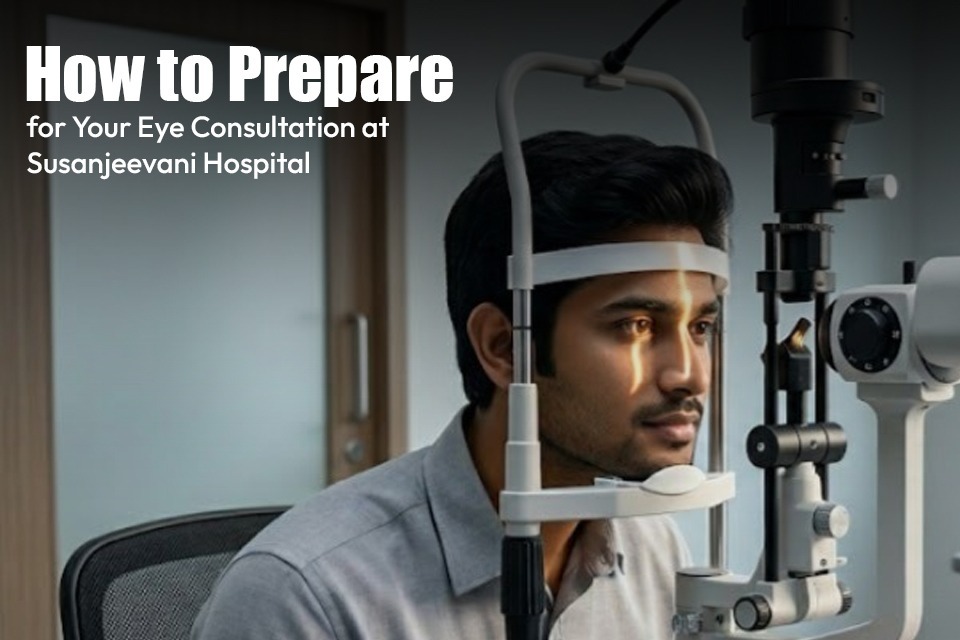
Visiting an eye hospital for the first time can feel a little overwhelming. You may not know what tests will be done, what to carry, whether your eyes will be dilated, or how long the whole process takes.
You are not alone. Every day at Susanjeevani Hospital — widely regarded as one of the best eye hospitals in Lucknow — we meet first-time patients who walk in uncertain of what to expect and walk out with a clear diagnosis, a proper treatment plan, and far less anxiety than they came in with.
Whether you are visiting us for a routine eye checkup in Lucknow, a diabetic eye examination, a cataract concern, or any other eye problem, this guide will help you prepare fully so your first consultation is as productive and smooth as possible.
Why Choosing the Right Eye Hospital in Lucknow for Your First Consultation Matters
Many patients in Lucknow visit an eye specialist only when something has already gone seriously wrong — when vision has become blurry, when eye pain has become unbearable, or when a family member insists they go. By that point, conditions like glaucoma, diabetic retinopathy, or cataract may have already progressed to a stage where treatment is more complex and outcomes are less predictable.
A proper, comprehensive first consultation at a well-equipped eye hospital in Lucknow does two critical things. It identifies any existing problems — many of which cause no early symptoms at all — and it establishes a baseline record of your eye health against which all future examinations can be compared.
At Susanjeevani Hospital, the best eye care center in Lucknow for superspeciality eye care, our first consultations are thorough and unhurried. We do not simply test your vision and hand you a prescription. Our eye specialists doctors examine the complete health of your eyes — from the front surface of the cornea all the way to the retina at the back — and explain every finding in plain, easy-to-understand language.
Step 1 — Book Your Appointment at the Best Eye Hospital in Lucknow in Advance
Walk-in patients are always welcome at Susanjeevani Hospital. However, booking an appointment in advance is strongly recommended. It reduces your waiting time, ensures the right eye specialist in Lucknow is available for your specific concern, and allows our team to allocate adequate time for a full examination — especially if you are coming for something complex like a diabetic retinopathy check, a glaucoma evaluation, or a pre-cataract surgery assessment.
How to Book Your Eye Consultation in Lucknow at Susanjeevani Hospital
- Call us directly at +91-8400868388
- Book online at susanjeevanihospital.in
- Walk in to our OPD: B 1/7 Mahanagar Extension, opposite Sahara India Centre, Kapoorthala, Lucknow — 226006
- OPD Timings: Monday to Saturday, 10:00 AM to 8:30 PM
When you call to book, mention your primary concern — whether it is blurry vision, eye pain, a routine eye checkup in Lucknow, a diabetes-related eye examination, a cataract evaluation, or anything else. This helps our team direct you to the most appropriate eye doctor in Lucknow for your needs.
Step 2 — Documents and Information to Carry to Your Eye Checkup in Lucknow
Coming prepared with the right information saves significant time and helps your eye specialist in Lucknow give you an accurate, complete diagnosis from the very first visit.
Documents to Bring
- Previous eye prescriptions or spectacle power cards — even if they are years old
- Earlier eye examination reports from any eye clinic in Lucknow or elsewhere
- Reports of any eye surgery undergone previously — cataract surgery, glaucoma surgery, squint correction, or vitreoretinal surgery — wherever it was performed
- Medical reports related to diabetes, hypertension, or thyroid disease — these conditions directly and significantly affect eye health and are among the most common reasons patients visit an eye hospital in Lucknow
- A list of all current medications or the medicine strips — certain drugs affect eye pressure, vision, and the retina
- Any identity document for registration
Medical History Information to Have Ready
- When did you first notice the problem you are visiting for?
- Is it affecting one eye or both?
- Has anyone in your family been diagnosed with glaucoma, cataract, or any inherited eye disease?
- Do you have diabetes, high blood pressure, or any autoimmune or inflammatory condition?
- Have you had any eye injuries in the past, even minor ones?
- Are you currently using any eye drops — prescribed or over the counter?
You do not need to memorise all of this. Simply think through these points before your appointment so you can answer your eye doctor's questions clearly. The more information your ophthalmologist in Lucknow has, the more precise your diagnosis will be.
Step 3 — What to Wear and What to Avoid Before Visiting the Eye Hospital in Lucknow
Remove Contact Lenses Before Your Eye Examination in Lucknow
If you wear contact lenses, remove them at least 2 to 4 hours before your appointment — or ideally the night before. Contact lenses temporarily alter the shape of your cornea, which affects the accuracy of refraction testing. This is the test that determines your exact spectacle power. Wearing glasses to your appointment instead of contact lenses gives your eye specialist in Lucknow the most accurate result.
Avoid Heavy Eye Makeup
Kajal, mascara, eyeliner, and eyeshadow can interfere with several eye tests and examinations. They can also cause contamination risk if a procedure is required. Come with clean, makeup-free eyes or remove all eye makeup before leaving for the hospital.
Bring Your Current Spectacles
Even if your glasses feel outdated or are old, bring them. Your eye doctor at Susanjeevani Hospital will compare your existing power to what your eyes actually need now. This comparison is valuable for tracking how your vision has changed over time — and is particularly important before cataract surgery in Lucknow or any other vision-correcting procedure.
Plan for Pupil Dilation — Bring Sunglasses and a Companion
During a comprehensive eye examination at our eye hospital, your ophthalmologist may dilate your pupils using special eye drops. This is a routine, completely painless procedure that allows the doctor to examine the retina, optic nerve, and blood vessels at the back of your eye — structures that cannot be examined adequately without dilation.
After dilation, your near vision will be blurry for 3 to 4 hours and you will be sensitive to bright light. Carry a pair of sunglasses for comfort, and if possible, bring a family member or friend who can drive or accompany you home — especially if you are travelling from areas like Alambagh, Charbagh, or Indira Nagar.
Step 4 — What Tests Are Done at Susanjeevani Hospital
Knowing exactly what to expect during your eye examination in Lucknow removes the anxiety of the unknown. Here is a plain-language explanation of every test that may be performed during your comprehensive consultation:
Visual Acuity Test — Checking How Clearly You See
This is the most familiar part of any eye checkup in Lucknow — reading letters or symbols from a chart at a fixed distance. It tells your eye specialist how clearly you can see at distance and near, and whether a correction is required. Both eyes are tested individually.
Refraction Test — Finding Your Exact Spectacle Power
This test determines the precise power of lenses needed to correct your vision. Your eye doctor will ask you to compare different lens options and indicate which gives you clearer vision. An automated device called an autorefractometer is also used to get an initial power reading before the manual test.
Eye Pressure Measurement — Screening for Glaucoma
This test measures the intraocular pressure — the fluid pressure inside your eye. Raised eye pressure is the most important risk factor for glaucoma, one of the leading causes of irreversible blindness.
Glaucoma treatment in Lucknow is most effective when the condition is detected early, before vision is lost. Eye pressure testing takes seconds, is completely painless, and is a routine part of every comprehensive examination at our eye hospital in Lucknow.
Slit Lamp Examination — Examining the Front of Your Eye
A slit lamp is a specialised microscope that allows your ophthalmologist in Lucknow to examine the eyelids, cornea, conjunctiva, lens, and anterior chamber in high magnification and fine detail.
This is how we detect early cataract formation, corneal disorders, dry eye disease, signs of uveitis, and other conditions affecting the front of the eye.
Dilated Retinal Examination — Looking at the Back of Your Eye
After dilating drops are applied, your eye specialist will examine the retina, macula, optic disc, and retinal blood vessels at the back of your eye using a special lens and light.
This examination is how we detect diabetic retinopathy, glaucomatous optic nerve damage, retinal detachment, macular degeneration, and other serious conditions — most of which cause no pain or early symptoms.
This is the single most important reason to choose a well-equipped eye hospital in Lucknow for your checkup rather than a basic optical shop or small clinic.
OCT Scan — Advanced Retinal and Nerve Imaging
OCT (Optical Coherence Tomography) is a highly advanced, completely non-invasive scan that produces a detailed cross-sectional image of your retina layers and optic nerve.
Susanjeevani Hospital has in-house OCT technology — one of the reasons it is considered the best eye hospital in Lucknow for conditions like glaucoma treatment, diabetic retinopathy treatment, and macular disease.
Your eye doctor will recommend an OCT scan if they need a more precise look at these structures than a clinical examination alone can provide.
Fundus Fluorescein Angiography — Mapping Your Retinal Blood Vessels
This is a specialised diagnostic test recommended for patients with diabetic retinopathy, retinal vein occlusions, or other retinal vascular conditions requiring detailed assessment before laser treatment or anti-VEGF injections.
A safe dye is injected into a vein in the arm and photographs are taken as it flows through the retinal blood vessels, revealing areas of leakage, blockage, or abnormal vessel growth in precise detail.
This investigation is available in-house at Susanjeevani Hospital — another key advantage of coming to a superspeciality eye hospital in Lucknow rather than a general clinic.
Step 5 — How to Communicate Effectively With Your Eye Specialist in Lucknow
The quality of your consultation at any eye hospital in Lucknow depends significantly on how well you communicate your symptoms. Here is how to do that effectively:
Be specific about your symptoms. Do not just say your eyes feel bad. Tell your eye doctor exactly what you experience — is it blurry vision, pain, redness, dryness, double vision, or something floating in your vision? Is it constant or does it come and go? Does it happen in certain situations — after long screen use, in bright sunlight, while reading, or when waking up in the morning?
Specify which eye is affected. Is the problem in both eyes or just one? If it is one eye, which one? This information narrows down the possible causes significantly and helps your ophthalmologist in Lucknow focus the examination.
Do not leave without a clear understanding of your diagnosis. At Susanjeevani Hospital, we believe every patient who visits our eye hospital deserves a clear, jargon-free explanation of what was found. If something is unclear, ask. There are no foolish questions when it comes to your eyesight.
Ask specifically about your treatment options. If a treatment is recommended — whether it is dry eye treatment in Lucknow, glaucoma eye drops, laser treatment for diabetic retinopathy, or cataract surgery in Lucknow — ask what the procedure involves, how long recovery takes, what outcome you can expect, and what happens if you wait or delay.
Always clarify your follow-up schedule. Most eye conditions seen at our eye clinic in Lucknow require monitoring over time, not just a one-time visit. Before leaving, ask your doctor when to return and what to watch out for in between.
Step 6 — What Happens After Your Consultation
Once your examination is complete, your eye doctor will explain their findings clearly and give you a prescription, treatment plan, or follow-up schedule.
If only a spectacle power correction is needed, you will receive a written prescription. Susanjeevani Hospital has an in-house refraction and opticals facility where you can get your glasses made on the same visit, saving you an extra trip.
If a condition such as cataract, glaucoma, diabetic retinopathy, dry eye disease, squint, or a retinal disorder is identified, your eye doctor in Lucknow will explain the stage of the condition, the treatment options available at our eye hospital, and what the likely outcome is with and without treatment. You will always be given adequate time to understand your options and discuss with your family before any decision is made.
If surgery such as cataract surgery in Lucknow, vitreoretinal surgery, squint surgery, or glaucoma surgery is recommended, you will receive complete pre-operative instructions, cost information, and recovery guidance. No patient at Susanjeevani Hospital is ever rushed into a decision.
How to Reach Susanjeevani Hospital
Address: B 1/7 Mahanagar Extension, opposite Sahara India Centre, Kapoorthala, Lucknow — 226006
Our eye hospital in Lucknow is easily reachable from all major areas of the city:
- From Gomti Nagar: approximately 15 minutes
- From Hazratganj: approximately 20 minutes
- From Indira Nagar: approximately 20 minutes
- From Alambagh: approximately 25 minutes
- From Charbagh Railway Station: approximately 25 minutes
Auto-rickshaws, e-rickshaws, and cab services are readily available in and around Kapoorthala. Parking is available outside the hospital for patients arriving by private vehicle.
Phone: +91-8400868388
Email: susanjeevanihospital@gmail.com
OPD Timings: Monday to Saturday, 10:00 AM to 8:30 PM